|
In this video, Greg shows you how to expand on what you learned by incorporating a full Blake roll and some hammer-ons.
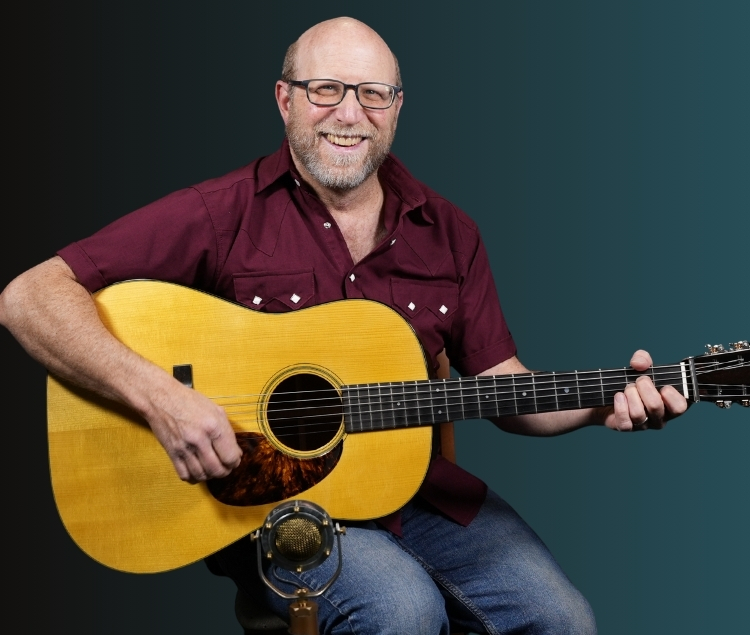
Greg gives you an overview of what you’ll learn in his Norman Blake–Style Guitar course.
In this introductory lesson, Greg provides you with the basic skills you’ll need to play Norman Blake–style guitar. Norman’s genius was to take Maybelle Carter’s approach to playing a melody on the lower strings along with strums on the upper strings and then take it up a notch. Using simple arpeggios and scales, Greg shows you how Norman takes the quarter-note bass/strum pattern, adds eighth-note strokes and strums, harmonizes the melody in double stops, and embellishes it all with hammer-ons and pull-offs. For this lesson, you will learn to play everything in C position—with or without a capo, which is consistent with Maybelle Carter’s playing. (For more on basic Carter-style playing, check out Cathy Fink’s Peghead course Maybelle Carter–Style Guitar.)
“Hand Me Down My Walking Cane” is a signature piece for Norman Blake. Some people attribute the song to 19th-century Black composer James A. Bland, a noted minstrel performer, but others claim it predates Bland. The first and perhaps the most influential recording of the song was by Gid Tanner and His Skillet Lickers with Riley Puckett in 1926. Blake himself recorded a terrific version in the key of A on his 1976 Whiskey Before Breakfast album (Greg will teach you that version in a future lesson). In this lesson, Greg teaches you the song in the key of D, but with the capo on the second fret using C-position chords.
There are hundreds of variants of “Long Journey Home,” also called “My Long Journey Home” or “Two Dollar Bill.” The song shares its musical DNA with a slew of ditties like “Gotta Travel On,” “Deadheads and Suckers,” “Worried Man Blues,” and many others. Among the first recordings of the version Norman Blake plays is the fiery 1936 setting by the Monroe Brothers. Greg teaches the song in the key of G in open position, using standard G, C, and D chords. As in the previous lesson, Greg shows you the basic melody first and then demonstrates how to play it in the Carter pick-strum style, then with the more complicated Blake roll, and finally a more embellished version.
This Norman Blake original sounds like an old ballad, and like many ballads with a linear narrative, “Billy Gray” repeats the same four-line melodic pattern throughout, with no chorus or bridge. First released on Blake’s 1975 Old and New album, it’s one of Norman’s most beloved songs. For the complete lyrics, check out the Musixmatch website. The final two lines of the song are typically repeated as a melancholy refrain.
“True love knows no season, no rhyme, nor no reason.
Justice is cold as the Granger County clay.”
Greg teaches “Billy Gray” in the key of F, with the capo on the fifth fret and playing in C position. Once again, you’ll learn the melody first, and then three increasingly complex arrangements.
Greg shows you another of Norman Blake’s most popular originals this month, a song Blake first released on his Whiskey Before Breakfast album in 1976. Many others have recorded and performed the song, including Tony Rice, Sierra Hull, and Punch Brothers, who put their own inimitable spin on this busker’s-eye view of being down and out in downtown Nashville. Blake first recorded the song in the key of F#, but he played it out of C position with a capo up the neck at the sixth fret. In more recent years, the capo has come down a step or so as his voice has dropped. For this lesson, Greg teaches it in the key of C in the open position. You can add a capo to find the spot that suits your own voice once you’ve learned how to play it. As in previous lessons, Greg starts you off by showing you how to play the melody on the bass strings before adding the picking and strumming elements that give it that Norman Blake feel. You’ll learn a more complex version of the song in a later lesson, but this will give you a serviceable version to play while you pick up more skills. Note that the nature of the melody doesn’t allow for a completely square boom-chuck rhythm. You’ll need to adjust your picking and strumming a little to make the two components dance well together.
This plaintive elegy for a fading way of life in the mountains is among the most frequently covered Norman Blake songs. Tony Rice, Billy Strings, the Seldom Scene, and a host of other bluegrass, old-time, and folk acts have performed and recorded it. It first appeared on the 1974 Fields of November album, a beautifully understated recording of Blake originals that showcased both his compositional skills and his prowess on a band’s worth of stringed instruments. “Last Train from Poor Valley” is a simple, three-chord song in verse-verse-chorus format. Greg teaches it in the key of G, Blake’s original key.
Blake’s stripped-down performance of this melancholy favorite opened the second side of his second solo album, The Fields of November, first released in 1974. Forty years later, Sara Watkins recorded a slightly more elaborate version of “Lord Won’t You Help Me” on her eponymous album. The song has a simple structure, with four short verses and a one-line refrain that changes slightly with each iteration. Like “Church Street Blues,” the lyrics portray a guitarist down on his luck, although in this case the protagonist is constantly on the move, not stuck in Nashville. On Blake’s original recording, he plays an instrumental version on the guitar between each verse, with flourishes that include most of the stylistic components you’ve been working on: a simple melody played on the bass strings with a lot of hammer-ons and pull-offs, double-string harmony notes, and syncopated strums fleshing out the chord structure. Even though the song has just three chords (I, IV, V), the form is slightly crooked and some of the changes are syncopated. Greg recommends learning how to sing the verse and refrain before tackling the guitar part so that you internalize the structure. He starts with a basic version and then shows you a more elaborate variation to play for the solos. Greg teaches the song in the original key of E played out of C position with a capo on the fourth fret.