|
John shows you a more complex approach to backing up “Mooney’s Reel” in this video.
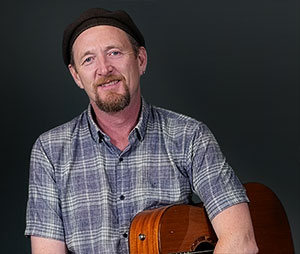
Traditional Irish music is fundamentally linked to dancing, and the essential repertoire comprises rhythmic dance tunes, primarily reels, jigs of various sorts, and hornpipes. John will introduce you to his approach to playing Irish music on the guitar with a thorough grounding in rhythmic accompaniment, starting with the guitar in dropped-D tuning: DADGBE.
Rigorous strumming-hand and forearm technique is at the heart of John’s driving accompaniment. Most of you use your right hand and arm for strumming and picking, but because John is left-handed, you’ll be seeing a mirror image of your own setup. In these first lessons, John introduces you to his very specific approach to choosing a pick, holding it, and using his forearm to power his strumming patterns. Once he’s shown you the foundations of his approach to rhythm guitar, he’ll give you some additional tips for accenting your steady strums to create more complex grooves.
In this section, John focuses on the essential skills you’ll need to accompany reels, the driving 4/4 dance tunes at the heart of the tradition. For those of you with backgrounds in bluegrass or old-time music, a reel is akin to a hoedown or breakdown. In these next lessons, John will introduce the basic chords and some variations for several of the main keys found in traditional Irish music, beginning with D and G. He’ll show you the fretting-hand chord forms in one or two octaves and introduce a popular session (seisiún) tune so that you can practice what you’ve learned on both hands in a practical context.
John uses these next lessons to introduce the primary chords he uses for playing in the key of D. One takeaway is the utility of learning “modal” chords without a clearly defined major or minor third in the triad. He also shows you how to imply a chord change by shifting just a note or two without playing a fully defined triad of the change chord.
Written by Sligo fiddler Michael Gorman, “The Mountain Road” was originally a six-part tune. In most sessions today, it’s played as a single, two-part tune in the key of D, with each part played just once. In these next lessons, John demonstrates a basic accompaniment pattern for “The Mountain Road” and follows that with a more embellished version.
John takes you on a journey similar to what you just explored in the previous set of lessons, this time in the key of G. You’ll learn the basic chords, build a harmonized scale with the rest of the chords for G, and then apply it all to developing basic and embellished accompaniment patterns to “Mooney’s Reel.”
Donegal fiddler Tommy Peoples often played this great tune in the key of G, and it is sometimes given his moniker. You might also find it called “The Milkmaid,” “Green Pease Straw,” and “Liam O’Flynn’s.” John shows you how to play a basic version of the accompaniment and then a more embellished approach.
The key of C isn’t nearly as common in Irish traditional music as tunes in the keys of D, G, or Am, but there are some great ones such as “My Maryanne,” which will be the basis of John’s lesson this month. Sometimes written as “My Marianne” or called “Boys of Galway,” this reel was ferreted out of the classic O’Neill’s Music of Ireland sheet-music collection and recorded by the Irish Tradition on their 1978 Corner House album. John recorded it with Solas in a three-tune medley on their Sunny Spells and Scattered Showers disc. It’s a “single” reel in AB format, with each eight-bar part played just once. John shows you how to build all the chords you’ll need to accompany the tune—or any other C tunes you’re likely to encounter—and then shows you a couple of ways to structure an accompaniment pattern.
John continues his tour of dropped-D tuning and reel accompaniment with a deep dive into the key of A. He notes that playing in this key is a little more challenging than what he’s shown you in previous lessons, and the chord forms might be a little more involved than what you are used to playing. But the key of A offers some great opportunities for playing up the neck, using different inversions with subtle nuances, and incorporating drone strings into your backup parts. Once you’ve learned the basic chord forms, John will show you how to use them to build a couple of backup patterns for “The Black-Haired Lass,” a great seisiún tune recorded by Altan, Eileen Ivers, Frankie Gavin, and dozens of others.
Your next stop in the dropped-D juggernaut is the key of A minor. Minor keys are more prominent in traditional Irish music than they are in most traditional American idioms, and there are scads of A minor tunes, as well as tunes in E minor, B minor, and D minor. In this lesson, John will give you the basic chords you’ll need for playing in this key, and then he’ll show you how to apply them to backing up “The Congress” reel, a wildly popular session tune. Named to commemorate the International Eucharistic Congress held in 1932 in Dublin, the tune is attributed to button accordion player Joe Mills. You can find dozens of recorded versions on YouTube, including this setting by Kevin Burke’s Open House. Once you have a basic accompaniment to “The Congress” in hand, John will show you several ways to embellish your backup.
This month John introduces a great three-part reel as a way to demonstrate his approach to playing in E minor. “The Cup of Tea” can be heard regularly at Irish sessions, and there are some wonderful recordings, including a classic duet on the 1994 Frankie Gavin and Alec Finn album. As in previous lessons, you’ll learn the first-position chord forms in dropped-D tuning and then some movable forms up the neck. After you’re comfortable playing through the harmonized E minor scale, John will show you a basic backup progression for “The Cup of Tea” followed by a more embellished version.