|
In this video, Bill shows you how to add the forward-reverse roll to the melody of “Worried Man Blues,” which you learned to play in an earlier lesson. You’ll be relieved to know that there isn’t a hard-and-fast rule about getting every single melody note into your solo. Your ear will fill in some of the missing notes, and the rolls will maintain the momentum of your solo.
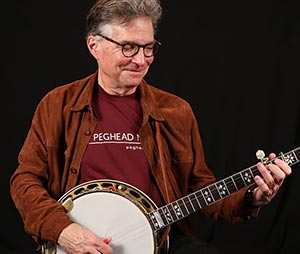
Bill gives you an overview of what you’ll learn in his Creating Bluegrass Banjo Solos course.
To build a good bluegrass solo from scratch, Bill advocates first learning the basic melody of the song or instrumental that you want to play. In this first lesson, he shows you a basic first-position G scale that will provide the building blocks for melodies within that key. Then he dissects the melody for “Cripple Creek,” a great banjo and fiddle tune, and shows you how that sounds when all the rolls and licks are stripped away. He does the same thing in more detail with three other bluegrass standards: “Worried Man Blues,” “Will the Circle Be Unbroken,” and “Blue Ridge Cabin Home.” You’ll revisit these songs later in the course, but for this lesson, you’ll focus on ferreting out the melody and chords.
Bill introduces two essential banjo rolls in this lesson—the forward-reverse roll and the alternating thumb roll—and shows you how to integrate them into the melody line of a song or tune. Bill suggests focusing on the right-hand picking pattern independent of the actual strings that you will be striking, which will give you more flexibility in the long run. In addition to learning two essential rolls in this lesson, you’ll see how to apply them to a couple of bluegrass classics: “Worried Man Blues” using the forward-reverse roll, and “I’ll Fly Away” using the alternating thumb roll and the forward-reverse roll.
The big breakthrough Earl Scruggs contributed to banjo technique was the forward roll, which he developed after putting a fingerpick on his middle finger. With that added digit he was able to articulate individual notes more clearly across all five strings than was possible with earlier clawhammer and two-finger styles. In this set of lessons, Bill introduces the forward roll and several variations, and then he shows you how to apply them in a number of contexts, including the classic songs “Will the Circle Be Unbroken” and “You Are My Sunshine.”
This month Bill introduces two new rolls. The first is called the “lick roll,” because it’s used to play one of the most common fill-in licks in bluegrass. After working on the roll itself, you’ll work it into the melody of “Worried Many Blues” for some variations on what you learned in the earlier forward-reverse roll lesson. The second roll is commonly called the “Foggy Mountain Breakdown” roll, so-called because—you guessed it—it’s the essential roll Earl Scruggs played on the quintessential bluegrass banjo tune “Foggy Mountain Breakdown.” It’s a little more complicated than some of the rolls you’ve already learned, and it isn’t limited to the title song: It can be used in lots of songs, too. In this lesson you’ll learn to apply it to “Way Downtown,” a Doc Watson and Stanley Brothers favorite.
American composer Henry Clay Work wrote "Grandfather's Clock" (popularly known as "My Grandfather's Clock") in 1876. It’s a standard for British colliery brass bands and bluegrass bands alike, and is often the basis for flashy arrangements on both cross-picked mandolin and three-finger banjo. Bill teaches “Grandfather’s Clock” in the key of G with a standard AABB format. The original song has four verses separated by an interlude/chorus that is often omitted in instrumental versions, which is the case in the arrangement here. Bill starts by showing you the basic melody, and then he melds in alternating-thumb and forward rolls to flesh out the bones into a full-fledged bluegrass banjo solo.